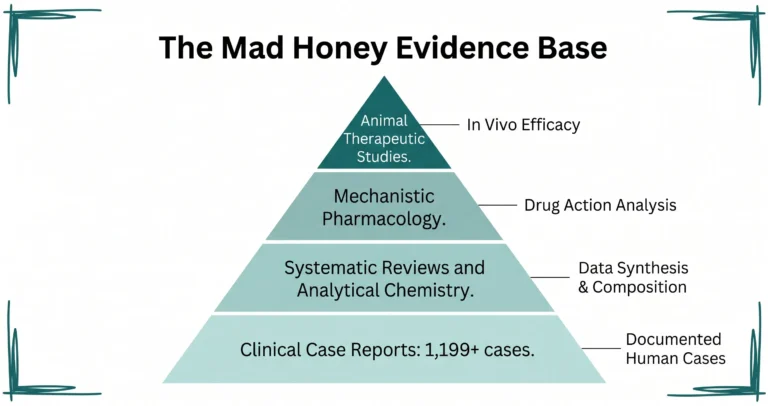
The peer-reviewed literature on mad honey and grayanotoxin is substantial in some areas and essentially absent in others. That asymmetry matters for anyone trying to understand what the evidence actually supports, and it is almost never stated accurately in non-academic coverage of the subject.
The mechanistic science is solid. How grayanotoxin disrupts voltage-gated sodium channels, the binding sites, the conformational change, and the inactivation failure, is well-established across decades of pharmacological research. The clinical management protocol is well-characterised: the case literature consistently shows bradycardia and AV block reversing with atropine, hypotension responding to IV saline, and most presentations resolving within 24 hours. The concentration and variability of GTX in honey are increasingly documented through analytical chemistry studies that provide rigorous quantitative data.
What is largely absent is controlled human research. No dose-response trial has established how GTX blood concentration relates to symptom severity in humans across a range of controlled exposures. No pharmacokinetic study has characterised absorption, distribution, metabolism, and excretion in a human volunteer population. No clinical trial has evaluated any therapeutic application of mad honey or grayanotoxin in humans. These gaps are not failures of the researchers working in this field; they reflect the regulatory and ethical constraints on conducting controlled human trials with a compound that produces measurable cardiovascular effects at the doses required to study it. But they are the central limitations that any honest reading of the literature must state.
Contents
- The Core Evidence Base: What Studies Exist
- Clinical Case Reports and Case Series: What They Tell Us
- Analytical Chemistry Studies: Quantifying What Is in the Honey
- Mechanistic Pharmacology Research: What Is Well-Established
- Animal Studies: Therapeutic Findings and Toxicological Concerns
- Geographic Bias and What It Means
- What Has Not Been Studied
- How to Access the Primary Literature
- What the Research Supports and What It Does Not
- Summary
- Sources
The Core Evidence Base: What Studies Exist
The mad honey research literature is organised into five areas: clinical case reports and case series; systematic reviews of the case literature; analytical chemistry studies measuring GTX concentration; mechanistic pharmacology research; and animal studies for therapeutic applications and toxicology. Each area has a different evidence quality profile and supports different types of claims.
| Study / Review | Type | Scale | Primary Contribution |
| Silici & Atayoglu (2015) | Systematic review | 1,199 cases | Largest case dataset (1,199 cases reported 1981 to 2014): demographics, ECG findings, treatment and outcomes |
| Ahn et al. (2022) | Analytical study | 60 honey samples | LC-MS/MS analysis of 60 Nepal honeys seized by Korean customs; 86-fold GTX I variability; no GTX I or III detected in 27 of 60 (45%) |
| Jansen et al. (2012) | Mechanistic review | Literature synthesis | Full VGSC mechanism; group II (site 2) receptor binding on the S6 segments; M2 receptor data from rat studies; case synthesis from Turkey and Nepal |
| Ullah et al. (2018) | Clinical review | Literature synthesis | Diagnosis without lab tests; 15–30g intoxication range; treatment hierarchy: saline to pacemaker |
| Aryal (2025) | Comprehensive review | Literature + Nepal cases | Most recent Nepal-authored synthesis; Nepal vs Turkey data; therapeutic potential; genotoxicity; blood thresholds |
| Ozhan et al. (2004) | Case series | 19 patients | Turkish emergency department series from 2002; hypotension and conduction disorders resolved with atropine within 24 hours; cited by Ullah et al. (2018) for poisoning after one teaspoon |
| Turkmen et al. (2013) | Animal study | Rat, IP injection | Dose-related HR reduction and BP reduction from GRAY-III; pharmacological basis for hypertension folk use |
| Sahin et al. (2018) | Animal study | Rat, oral gavage | Fracture healing better than controls at 30 days and similar to propolis; no significant difference from controls at 15 days; never significantly better than normal honey; honey not assayed for grayanotoxin |
| Eraslan et al. (2018) | Genotoxicity study | Rat, multiple regimens | Oxidative stress at all three regimens; comet assay changes in some tissues; EFSA judged the genotoxicity evidence unclear |
| Yeşil Sarsmaz et al. (2024) | Reproductive tox. | Female rat, 30 days | Ovarian follicular atresia and caspase-3 apoptosis at 80 mg/kg |
| Schrenk et al., EFSA (2023) | Risk assessment | European Food Safety Authority | Scientific opinion for the European Commission, not a regulation; health concerns for acute toxicity and evidence of genotoxicity in mice; calls for analytical standards, occurrence data and further toxicity studies; does not assess therapeutic benefit |
Clinical Case Reports and Case Series: What They Tell Us
The overwhelming majority of the mad honey research literature is case-report-based. A case report records what happened to a specific patient: what they consumed, what symptoms appeared, what treatment was given, and what the outcome was. A case series extends this to multiple patients. Neither design establishes dose-response relationships in the controlled sense; they document associations, not mechanisms, and they capture only patients who reached medical care.
Case reports and case series are the correct methodology for characterising a rare or semi-rare toxic exposure. Conducting a controlled dose-escalation trial with a compound that produces bradycardia and hypotension would be ethically unjustifiable. The case literature is therefore not a methodological shortcoming; it is the most appropriate available approach for initial clinical characterisation.
What case reports can establish
Case reports reliably establish: which symptoms appear and in what sequence; what treatments work and at what doses; what the typical clinical course looks like; and which patient populations are at elevated risk. The Ullah et al. (2018) clinical management review, synthesising the case literature to that date, produced the finding that clinical diagnosis can be made without laboratory testing, on history and physical examination alone. That is a clinically useful conclusion derived from case series data, and it is appropriately scoped: it says what the clinical picture looks like reliably enough to act on, not what the dose-response relationship is.
What case reports cannot establish
Case reports cannot reliably establish: dose-response relationships (because the GTX concentration of the honey consumed is almost never measured); incidence rates (because only patients who sought treatment enter the dataset); long-term effects (because follow-up rarely extends beyond discharge); or therapeutic efficacy (because the patients in the record presented with adverse effects, not intended benefit). Every claim in the mad honey literature that uses case-series data to support a dose threshold, a safety margin, or a therapeutic claim is extending that data beyond what its methodology supports.
The dominant dataset
The Silici and Atayoglu (2015) systematic review of 1,199 cases is the most rigorous aggregate of the case evidence and provides the best available statistical picture of demographics, severity distribution, treatment protocols, and outcomes. Most cases reported worldwide involve honey from Turkey (91.44% of the 900 cases compiled by Gunduz et al. 2023), and the review names R. ponticum and R. luteum as the source plants, so its figures cannot be assumed without qualification to characterise the full clinical spectrum of other origins or other patient populations.
Analytical Chemistry Studies: Quantifying What Is in the Honey
Analytical chemistry studies measure what the honey contains rather than what happens when it is consumed. They apply LC-MS/MS or HPLC methods to honey samples to quantify GTX I, II, and III concentrations. This research area has grown significantly since the early 2000s as sensitive analytical methods became more accessible, and it has produced some of the most practically significant findings in the entire literature.
The most consequential finding is the scale of batch-to-batch concentration variability. Ahn et al. (2022) analysed 60 Nepal samples seized by Korean customs; among the 33 in which toxin was quantified, GTX I ranged from 0.75 to 64.86 µg/g, an 86-fold difference. GTX III showed a 255-fold range across the same dataset. Crucially, 45% of samples had no GTX I or GTX III detected, despite having been transported specifically as mad honey.
Turkish studies compiled in the Aryal (2025) review show comparable internal variability. Multiple studies on the same origin, using the same analytical method, produce wide ranges that do not converge on a characteristic concentration profile. The data from both origins confirms that geographic label and provenance claim are insufficient to determine what is in any specific batch.
This research area directly undermines gram-weight dosing guidance. Any statement that a specific number of grams of mad honey is safe, or produces a specific effect, without reference to the batch GTX concentration, is pharmacologically imprecise. The analytical chemistry literature establishes this not as a theoretical concern but as a quantitative fact measured in real samples.
Mechanistic Pharmacology Research: What Is Well-Established
The voltage-gated sodium channel mechanism of grayanotoxin is the best-established area in the entire literature and the least contested. Site-directed mutagenesis of the Nav1.4 channel has placed the grayanotoxin receptor on the S6 segments of all four domains (Ishii et al. 1999; Kimura et al. 2000; Maejima et al. 2003), with two residues in domain IV segment 6, Phe-1579 and Tyr-1586, proposed to control the toxin’s access and its binding respectively (Maejima et al. 2003). Grayanotoxin binding removes fast inactivation, so channels stay open. Voltage clamp electrophysiology experiments have characterised the inactivation failure that results. Rat experiments with atropine and a selective M2 blocker implicate M2 muscarinic receptors in the bradycardia, though not in the respiratory depression (as reviewed by Jansen et al. 2012); the clinical response to atropine is consistent with this. Grayanotoxin acts at what Jansen et al. (2012) call the group II receptor site of the sodium channel. It belongs to a group of lipid-soluble sodium channel toxins, with batrachotoxin, veratridine and aconitine, whose receptor sites lie on the S6 segments of the channel (Wang and Wang 2003); its site overlaps with, but is not identical to, that of batrachotoxin (Ishii et al. 1999; Kimura et al. 2000).
This mechanistic certainty is an important context for reading the rest of the research. Everything downstream of VGSC disruption, cardiovascular effects, neurological effects, therapeutic potential, and toxicity follows predictably from this established mechanism. There is no mystery about why GTX does what it does. The open questions concern dose-response, individual sensitivity, concentration variability, and long-term effects, not the primary pharmacological event.
Animal Studies: Therapeutic Findings and Toxicological Concerns
Animal studies constitute the primary evidence base for both the therapeutic potential of mad honey and the emerging toxicological concerns. Understanding what they establish, and what they do not, requires matching the claim to the study design.
Therapeutic evidence at the animal level
The therapeutic potential of grayanotoxin is documented across several application areas in rodent models. Sahin et al. (2018) found that mad honey at 80 mg/kg by oral gavage improved femur fracture healing in female Sprague-Dawley rats compared with untreated controls at 30 days, to a similar degree as propolis, but not at 15 days, when only propolis did. Oztasan et al. (2005) documented blood glucose and lipid reduction in rats with streptozotocin-induced diabetes and in control rats. Turkmen et al. (2013) showed that GRAY-III given to rats by IP injection at 0.2, 0.4, and 0.8 mg/kg lowered heart rate in a dose-related way, and lowered blood pressure after 0.2 and 0.8 mg/kg. Gündüz et al. (2012) documented anti-epileptiform activity in rats given GRAY-III by injection into the brain ventricles, though the authors concluded that grayanotoxin is not directly responsible for the seizures seen in poisoning.
None of these findings has been replicated in human trials. They establish that the pharmacological mechanisms underlying these applications exist and are measurable in controlled animal models. Whether those mechanisms translate to human therapeutic applications at safe, consistent doses is a separate question, and one that no study has yet answered.
Genotoxicity and reproductive toxicity
The genotoxicity literature represents a concern that the earlier clinical reviews did not address. Eraslan et al. (2018) found oxidative stress and some comet assay changes in rats given mad honey at acute, subacute, and chronic dose regimens, though EFSA judged the genotoxicity evidence from this study unclear. Rasgele et al. (2021) documented chromosomal aberrations and increased micronucleated erythrocytes in mice. Yeşil Sarsmaz et al. (2024) found ovarian follicular atresia and caspase-3 apoptosis markers in female rats at 80 mg/kg over 30 days.
All of these findings are animal evidence at specific dose levels that may not correspond to typical human consumption in GTX exposure terms, particularly given the batch concentration variability, which means the same gram weight from different batches delivers fundamentally different GTX loads. The findings are not grounds for dismissal and should be in the record. They are also not grounds for direct extrapolation to human clinical risk at typical intake amounts. Both statements are accurate simultaneously.
Geographic Bias and What It Means
The clinical literature is concentrated in Turkey to a degree that affects how broadly its findings generalise. Turkish cases involve honey from R. ponticum and R. luteum (Silici and Atayoglu 2015), consumed by patients in the Black Sea coastal region with generational cultural familiarity with the product. That context shapes the demographics, the severity distribution, and the treatment outcomes documented in the primary dataset.
Nepal contributes a growing case record, documented primarily in the Aryal (2025) review, but one that almost certainly underrepresents actual incidence given the rural, highland context in which most consumption occurs. Korean, European, and North American cases are appearing with increasing frequency but remain a small fraction of the published record.
The geographic concentration matters for three reasons. First, the isoform profile of Turkish honey may differ from that of Nepal and other origins in clinically relevant ways. EFSA treated GTX I and GTX III as similarly potent when it set a single reference point for their sum (Schrenk et al. 2023), so whether a different isoform ratio changes the clinical picture has not been established. Second, the patient demographics of the primary Turkish dataset, predominantly middle-aged males with cultural context for consumption, may not represent the global consumer population engaging with mad honey through online retail. Third, the severity and outcome data are most robust for Turkish presentations and may not fully characterise presentations in populations with different baseline health profiles, medication use, or consumption patterns.
What Has Not Been Studied
This is the section of the mad honey literature that most coverage omits entirely, and it is the most important for calibrating what any specific claim can and cannot be trusted to mean.
No controlled human pharmacokinetic study exists. How GTX is absorbed, distributed, metabolised, and eliminated in humans, and how those processes vary with age, body weight, metabolic rate, and the food matrix in which the honey is consumed, has not been systematically studied. The rapid resolution of symptoms suggests efficient clearance, but the metabolic pathway remains uncharacterised. Without pharmacokinetic data, dose-response relationships in humans cannot be established with the precision needed to support either dosing guidance or therapeutic recommendations.
No dose-response trial has been conducted in humans. The 15 to 30 gram intoxication range cited in the clinical literature comes from case reports where honey concentration was not measured. This is an observation about what produced adverse events in documented presentations, not a validated pharmacological threshold derived from controlled human exposures.
No clinical trial has evaluated any therapeutic application. The animal evidence for blood pressure reduction, blood glucose lowering, fracture healing enhancement, and anti-epileptiform activity has existed for years. The research required to determine whether any of these effects translate to human therapeutic use at a safe and consistent dose, a controlled trial, has not been conducted for any application. The absence of such a trial is not evidence that the application does not work. It is evidence that the claim cannot be made.
The sub-hospitalisation exposure population is essentially undocumented. Everyone who consumed mad honey, experienced mild tingling or dizziness, and recovered at home without seeking medical care is invisible in the clinical record. Their experience, and the dose-effect relationships below the hospitalisation threshold, represent a substantial blank in the evidence base.
How to Access the Primary Literature
The peer-reviewed literature on mad honey and grayanotoxin is published primarily in toxicology, emergency medicine, pharmacology, and food chemistry journals. PubMed (pubmed.ncbi.nlm.nih.gov) is the primary accessible database for English-language peer-reviewed research. Useful search terms include: grayanotoxin, mad honey intoxication, mad honey disease, deli bal poisoning, grayanotoxin poisoning.
The Aryal (2025) review, available via Wiley Online Library at DOI 10.1002/jat.4855, is the most complete single reference for the 2025 state of the field and contains a bibliography of 101 references. The CMHI Research & References section holds full article-length summaries of the four most significant individual studies, each with the source paper DOI for direct journal access. Full-text access to papers behind paywalls typically requires an institutional library subscription or inter-library loan.
What the Research Supports and What It Does Not
Correctly characterising evidence strength is the point at which most coverage of mad honey research fails. The tiers below map the research areas to what they actually support.
Strongly supported
Grayanotoxin disrupts voltage-gated sodium channels and produces a consistent cardiovascular and neurological syndrome, bradycardia, hypotension, and AV block that resolves with atropine and IV fluid treatment. Batch GTX concentration is highly variable, spanning two orders of magnitude within a single geographic origin. The clinical presentation is diagnostically recognisable without laboratory testing. Atropine is an effective treatment in the majority of documented cases.
Moderately supported, animal evidence only
Blood pressure reduction, blood glucose lowering, fracture healing enhancement, and anti-epileptiform activity in rodent models at specific dose regimens. The pharmacological mechanisms underlying these applications are real and measurable in animal models. Human clinical translation is not established.
Documented concern, not yet characterised in humans
Genotoxicity in rodent studies, most clearly after short-term dosing in mice (Rasgele et al. 2021). Ovarian toxicity in female rats given 80 mg/kg for 30 days (Yeşil Sarsmaz et al. 2024). Neither finding has an equivalent human study. Cucer and Eroz (2010) found no genotoxic effects from GRAY-II and GRAY-III on cultured human lymphocytes in vitro, a different model and a different exposure than the rat studies.
Not supported by the research
Safe dosing thresholds at any gram weight without batch concentration data. Therapeutic claims for any human application. Ranking of mad honey origins by potency. The classification of GTX as a psychoactive or hallucinogenic compound.
Summary
The mad honey research field is better in some areas than is commonly recognised and weaker in others than is commonly claimed. The mechanistic science, how GTX works at the cellular level, is well-established. The clinical management protocol, atropine, saline, ECG monitoring, and a pacemaker when required, is well-supported by the case record. The analytical chemistry of batch variability is increasingly quantified.
The therapeutic potential has genuine pharmacological grounding in animal studies but no human clinical trial data. The genotoxicity and reproductive toxicity findings are in the record and should not be dismissed, but they are animal evidence at specific dose levels and have not been characterised in humans. The geographic concentration of the primary case record in Turkey creates real interpretive constraints on applying findings to other origins and populations.
The most consequential gap is the absence of controlled human data: no pharmacokinetic study, no dose-response trial, no therapeutic trial. Every practical question about safe consumption or therapeutic use ultimately runs into this gap. Acknowledging it is the starting point for an honest reading of the evidence.
Sources
- Ahn SY, Kim S, Cho H (2022), Determination of Grayanotoxin I and Grayanotoxin III in mad honey from Nepal using liquid chromatography-tandem mass spectrometry. Analytical Science and Technology 35(2):82-91.
- Aryal M (2025), Grayanotoxins in Mad Honey: Mechanisms of Toxicity, Clinical Management, and Therapeutic Implications. Journal of Applied Toxicology 45(11):2240-2256.
- Cucer N, Eroz R (2010), Investigation of mutagenic effects of grayanotoxins II and III on cultured human lymphocytes. Al Ameen Journal of Medical Sciences 4:293-299.
- EFSA CONTAM Panel (2023), Risks for human health related to the presence of grayanotoxins in certain honey. EFSA Journal 21(3):7866.
- Eraslan G, et al. (2018), Effect on oxidative stress, hepatic chemical metabolizing parameters, and genotoxic damage of mad honey intake in rats. Human & Experimental Toxicology 37(9):991-1004.
- Gündüz A, et al. (2012), Is grayanotoxin directly responsible for mad honey poisoning-associated seizures?. Turkish Journal of Medical Sciences 42:1086-1092.
- Gunduz A, Şimşek P, Ayaz FA (2023), Worldwide distribution and clinical characteristics of mad honey poisoning cases. Central European Journal of Public Health 31(1):69-73.
- Ishii H, et al. (1999), Point-Mutations Related to the Loss of Batrachotoxin Binding Abolish the Grayanotoxin Effect in Na+ Channel Isoforms. The Japanese Journal of Physiology 49(5):457-461.
- Jansen SA, et al. (2012), Grayanotoxin Poisoning: ‘Mad Honey Disease’ and Beyond. Cardiovascular Toxicology 12(3):208-215.
- Kimura T, et al. (2000), On site of action of grayanotoxin in domain 4 segment 6 of rat skeletal muscle sodium channel. FEBS Letters 465(1):18-22.
- Maejima H, et al. (2003), Distinct Sites Regulating Grayanotoxin Binding and Unbinding to D4S6 of Nav1.4 Sodium Channel as Revealed by Improved Estimation of Toxin Sensitivity. Journal of Biological Chemistry 278(11):9464-9471.
- Ozhan H, et al. (2004), Cardiac emergencies caused by honey ingestion: a single centre experience. Emergency Medicine Journal 21(6):742-744.
- Öztaşan N, et al. (2005), Effects of mad honey on blood glucose and lipid levels in rats with streptozocin-induced diabetes. Turkish Journal of Veterinary and Animal Sciences 29(5):1093-1096.
- Rasgele PG, et al. (2021), Investigation of genotoxic effects of rhododendron honey using three mammalian bioassays in vivo. Drug and Chemical Toxicology 45(5):2301-2310.
- Sahin A, et al. (2018), A Comparison of the Effects of Grayanotoxin-Containing Honey (Mad Honey), Normal Honey, and Propolis on Fracture Healing. Medical Principles and Practice 27(2):99-106.
- Silici S, Atayoglu AT (2015), Mad honey intoxication: A systematic review on the 1199 cases. Food and Chemical Toxicology 86:282-290.
- Türkmen S, et al. (2013), The dose-dependent effect of grayanotoxin on the cardiovascular system. Turkish Journal of Medical Sciences 43(5):700-705.
- Ullah S, et al. (2018), Mad honey: uses, intoxicating/poisoning effects, diagnosis, and treatment. RSC Advances 8(33):18635-18646.
- Wang SY, Wang GK (2003), Voltage-gated sodium channels as primary targets of diverse lipid-soluble neurotoxins. Cellular Signalling 15(2):151-159.
- Yeşil Sarsmaz H, et al. (2024), The relationship between oxidative stress and apoptosis of histopathological changes in the ovary made by mad honey containing grayanotoxin. Food and Chemical Toxicology 187:114634.
→ Jansen et al. (2012) CMHI entry: full VGSC mechanism, M2 receptor data, historical case synthesis.
→ Ullah et al. (2018), CMHI entry: clinical diagnosis without lab tests, treatment hierarchy.
→ Aryal (2025) CMHI entry: the most comprehensive single reference for the 2025 state of the field.