Mad honey, honey containing grayanotoxins from Rhododendron species, is not prohibited to possess, buy, or consume in Germany as of September 2026, but the German Federal Institute for Risk Assessment advises against consuming Rhododendron honey from the Turkish Black Sea region.
Germany is the most instructive jurisdiction in this set, because it is the one where the gap between legal status and official safety assessment is explicit rather than inferred. A federal body has examined this specific honey, concluded that it is not to be regarded as safe as a food, and published a recommendation against eating it. The honey remains lawful. Both statements are true simultaneously, and understanding why is more useful than either on its own.
Contents
Legal classification
Germany classifies mad honey as a food. Grayanotoxin is not a controlled substance under German narcotics law, and no German instrument prohibits the sale or import of honey containing it.
The distinction that Germany makes visible is between risk assessment and risk management. The Bundesinstitut für Risikobewertung, the Federal Institute for Risk Assessment, is a scientific body that assesses risk and publishes opinions. It does not make law, issue prohibitions, or conduct enforcement. Its recommendation carries scientific authority and no legal force. Enforcement sits with the food control authorities of the Länder, operating under the general food safety standard, and no prohibition has followed from the assessment.
Governing instrument
Three instruments operate together, and the relationship between them explains the position.
The safety standard
Regulation (EC) No 178/2002 applies directly in Germany as European Union law and supplies the substantive standard. Article 14 provides that food must not be placed on the market if it is unsafe, meaning injurious to health or unfit for human consumption, and Article 14(4) sets out the criteria for assessing injury, including probable cumulative toxic effects and the particular health sensitivities of specific consumer groups.
This is the same standard that applies in the United Kingdom, which makes the comparison between the two jurisdictions precise. They share a test and differ in whether a national body has applied it to this product and said so publicly.
The domestic framework
The Lebensmittel- und Futtermittelgesetzbuch, the German Food and Feed Code, provides the domestic machinery through which Article 14 is enforced, including inspection, sampling, and the powers exercised by the Länder food control authorities that carry out enforcement in practice.
The labelling rules and why they matter here
The Honigverordnung, the German Honey Ordinance, implements the European honey directive and governs composition and labelling. Its significance for mad honey lies in what it does not require.
The BfR has noted that the Honigverordnung mandates declaration of the country of origin, or of the countries of origin for blended honey, and permits the formulation of blends of honey from EC countries and non-EC countries. It requires no declaration of the region within a country, and none of the floral variety.
The consequence is a direct practical problem for the advisory. The BfR recommendation is framed by region and variety, specifically Rhododendron honey from the Turkish Black Sea region. The labelling rules do not require either to be declared. A consumer attempting to follow the recommendation cannot reliably identify the product it concerns from the information the label is obliged to carry.
The BfR assessment
The BfR prepared an opinion after a poisoning case involving grayanotoxin-containing honey was reported to the Hessian consumer protection ministry, and maintains a published question and answer document that was updated on 3 May 2023.
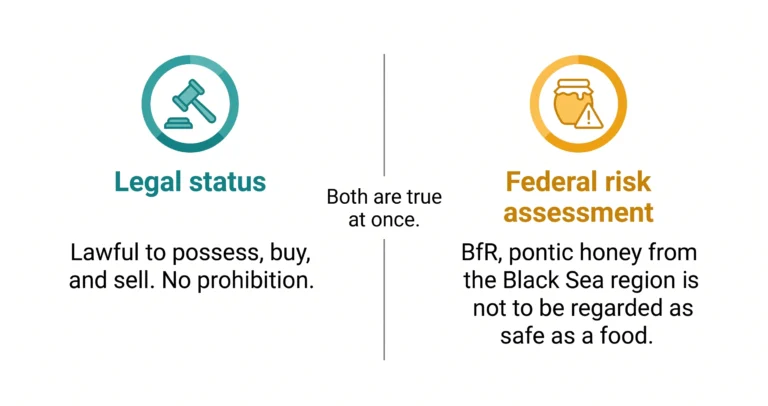
The institute concluded that pontic honey from the Black Sea region, consumed as a food, is not to be regarded as safe, and recommends that Rhododendron honeys from the Turkish Black Sea region not be consumed. Part of its reasoning concerns production practices. These honeys are frequently produced by local beekeepers without blending, so the dilution of grayanotoxin that would otherwise occur through mixing with honey from other sources does not take place.
| BfR finding | What the institute states |
| Overall conclusion | Pontic honey from the Black Sea region, consumed as a food, is not to be regarded as safe |
| Recommendation | Rhododendron honeys from the Turkish Black Sea region should not be consumed |
| Quantity | No precise amount can be identified at which poisoning occurs. Literature figures range between 5 and 180 grams |
| Worst case | In the least favourable case, a teaspoon could suffice to produce symptoms |
| Concentration observed | Grayanotoxin contents of up to 74 milligrams per kilogram have been detected |
| Susceptibility | People with cardiovascular disease taking blood pressure-lowering medication appear more susceptible |
| German domestic honey | Rhododendron species in Germany are ornamental and do not dominate the vegetation, so concentrations in honey from German Rhododendron blossom are not regarded as presenting a risk |
The reason the BfR declines to name a threshold is the same reason this subject resists simple guidance generally. Honeys differ in composition and in grayanotoxin content, so a quantity that produces nothing from one jar may produce symptoms from another. A range spanning 5 to 180 grams is not imprecision in the assessment. It is an accurate description of a product whose potency is not fixed.
Documented German cases
The BfR records specific incidents. In 2012, a 56-year-old man developed pronounced symptoms including slowed heartbeat, falling blood pressure, circulatory weakness, and abdominal pain after consuming two tablespoons of honey from the Black Sea region, and recovered fully. In 2019, a 40-year-old man developed severe symptoms, including clouding of consciousness and slowed heartbeat, after consuming honey from the same region.
These are useful precisely because they are domestic and documented by a federal body. They establish that the exposure route into Germany is real rather than theoretical, and the 2012 case indicates the quantity involved.
Import and customs
No German or European Union import prohibition specific to mad honey or grayanotoxin was identified as of September 2026. Honey imported from outside the European Union is subject to the general controls applying to imported food, and enforcement within Germany is carried out by the food control authorities of the Länder.
Honey assessed as unsafe within the meaning of Article 14 may be withdrawn or recalled from the market under the obligations that Article imposes on food business operators. A BfR recommendation does not by itself trigger those obligations, because the BfR assesses risk and does not exercise enforcement powers. The obligation falls on the operator and is triggered by the operator’s own assessment that food it has placed on the market may be injurious to health.
Enforcement record
No German prosecution, product recall, or market withdrawal specific to grayanotoxin-containing honey was identified as of September 2026.
What exists instead is the BfR opinion and its published recommendation, which is advisory. Germany therefore presents a documented federal assessment that a category of honey is not safe as a food, without a corresponding prohibition or identified enforcement action having followed from it. That combination is unusual and is the single most important fact about the German position.
What legality does not mean
Germany illustrates the gap between legality and safety more directly than any other jurisdiction covered here, because the gap is not inferred from an absence of assessment. It is visible in the presence of one. A federal risk assessment body has stated that this honey is not to be regarded as safe, and the honey remains lawful to sell and to consume. By contrast, legality under Texas law reflects criminal and regulatory classification alone, with no assessment of the honey behind it.
Anyone citing German law to establish that mad honey is acceptable is therefore citing only half the record. The legal position and the official scientific assessment point in different directions, and both are published.
Concentration determines effect, varies substantially between batches, and is not declarable under the labelling rules that apply. The Cliff Mad Honey Safety Standard: GTX Concentration Risk Classification (v1.0) sets out how measured concentrations are classified.
What is not established
No numeric grayanotoxin limit for honey exists in German or European Union law. The BfR recommendation is not a limit and does not function as one.
No determination by a German enforcement authority, as distinct from the BfR assessment, was identified. Whether any Land food control authority has acted on the BfR opinion was not established.
Whether any European Union measure addressing grayanotoxins in honey has been adopted or is in preparation was not examined for this page.
Key points
Mad honey is lawful to possess, buy, and consume in Germany. Grayanotoxin is not a controlled substance, and no instrument prohibits the honey.
Against that, the Bundesinstitut für Risikobewertung has assessed pontic honey from the Black Sea region as not safe for consumption as a food, and recommends against eating Rhododendron honey from the Turkish Black Sea region. It reports literature figures ranging from 5 to 180 grams for the quantity producing poisoning, notes that a teaspoon could suffice in the least favourable case, records contents up to 74 milligrams per kilogram, and documents German poisoning cases in 2012 and 2019. It also notes that people taking blood pressure-lowering medication appear more susceptible, and that honey from German ornamental Rhododendron is not regarded as presenting a risk.
The recommendation is advisory. The BfR assesses risk and does not enforce it, and no prohibition, recall, or market withdrawal was identified. The Honigverordnung compounds the practical difficulty by requiring country-of-origin labelling without requiring region or floral variety, so the honey the advisory concerns cannot be reliably identified from the label.
- Is Mad Honey Legal? Country by country legal status hub.
- Is Mad Honey Legal in the UK? The same Article 14 standard without an equivalent published national assessment.
- Is Mad Honey Legal in the US? A food classification reached through a separate statutory structure.
- The Cliff Mad Honey Safety Standard: GTX Concentration Risk Classification (v1.0).
Sources
- BfR, Selected Questions and Answers on Grayanotoxins in Honey. The German Federal Institute for Risk Assessment advises that rhododendron honeys, especially from the Black Sea region, should not be consumed, and states that a safe intake level cannot currently be derived.