Mad honey, honey containing grayanotoxins from Rhododendron species, is not a controlled drug in the United Kingdom and is not prohibited to possess, buy, or consume as of September 2026.
The United Kingdom reaches that conclusion by a different route from the United States, and the difference is substantive rather than presentational. American food law asks whether a quantity ordinarily renders a food injurious, a question that becomes difficult to answer without a numeric threshold. British food law asks whether a food is unsafe, and supplies a structured list of considerations for deciding that without requiring any threshold at all. The practical consequence is that the absence of a grayanotoxin limit in UK law leaves less of a gap than the equivalent absence in the United States.
Contents
Legal classification
The United Kingdom classifies mad honey as a food. Grayanotoxin is not listed in the schedules to the Misuse of Drugs Act 1971, so the possession, supply, and production offenses created by that Act do not apply to it. Nor was any Temporary Class Drug Order or Psychoactive Substances Act designation identified.
UK food law does not classify products as permitted or prohibited by name. There is no list of approved foods from which mad honey is absent, and no list of banned foods on which it appears. A single standard applies to all food, which is whether the food is safe, and the offenses attach to placing unsafe food on the market rather than to possessing or consuming it.
That structure is why the question of whether mad honey is legal in the UK is slightly misframed. Nothing makes it legal in the sense of a positive authorization. It is lawful in the same conditional way that all food is lawful, and the condition is the one set out below.
Governing instrument
Two instruments operate together, one supplying the substantive test and the other the domestic enforcement machinery.
The safety standard
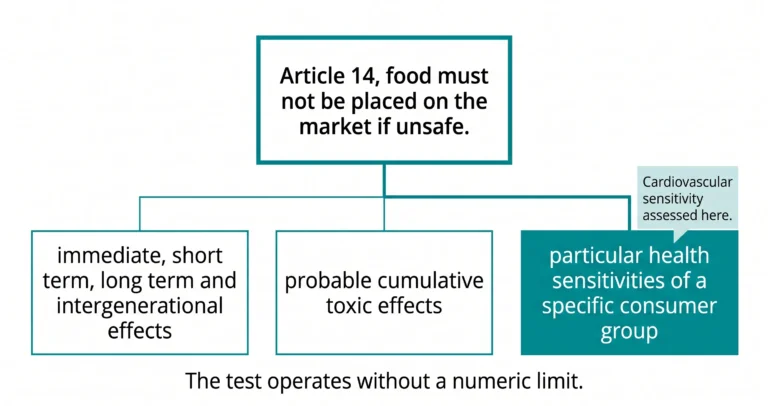
Regulation (EC) No 178/2002, the General Food Law Regulation, continues to apply in UK law following the United Kingdom’s withdrawal from the European Union. Article 14 provides that food must not be placed on the market if it is unsafe, and defines unsafe as injurious to health or unfit for human consumption.
Article 14(4) is the provision that does the work for mad honey. In determining whether food is injurious to health, regard must be had to three things. First, not only the probable immediate, short-term, or long-term effects of that food on the health of a person consuming it, but also on subsequent generations. Second, the probable cumulative toxic effects. Third, the particular health sensitivities of a specific category of consumers for whom the food is intended for that category.
Each of those limbs has a clear application here. The first captures the acute cardiovascular effects of grayanotoxin. The second is the limb under which repeated consumption would be considered. The third is the most directly relevant, because the people most affected by a compound that lowers heart rate and blood pressure are those with cardiovascular conditions or taking medication acting on the same parameters.
The enforcement machinery
The Food Safety Act 1990 provides the domestic framework and creates the principal offenses. Section 8 provides that food fails to comply with food safety requirements if it is unsafe within the meaning of Article 14. Section 7 creates the offense of rendering food injurious to health, and Section 14 the offense of selling to a purchaser’s prejudice any food not of the nature, substance, or quality demanded.
Section 14 deserves particular note in this context. It addresses food that is not what the purchaser was led to expect, which is a different failing from food that is unsafe. Honey sold as mad honey that contains no detectable grayanotoxin, and honey sold as ordinary honey that contains a substantial quantity, are both potentially within its scope, on facts that would have to be established in each case.
| Provision | What it addresses | Relevance to mad honey |
| Art. 14, Reg. 178/2002 | The substantive standard: food must not be unsafe | The operative test. No numeric threshold required to apply it |
| Art. 14(4)(c) | Health sensitivities of specific consumer groups | The limb capturing cardiovascular risk in susceptible people |
| Food Safety Act 1990, s.8 | Failure to comply with food safety requirements | Links the domestic offense to the Article 14 standard |
| Food Safety Act 1990, s.14 | Food not of the nature, substance, or quality demanded | Potentially engaged by misdescription of grayanotoxin content |
| Misuse of Drugs Act 1971 | Controlled drugs and the offenses attaching to them | None. Grayanotoxin is not scheduled |
No UK determination that mad honey as a category is unsafe within the meaning of Article 14 was identified. The assessment is made case by case on evidence about the particular food, and the absence of a category determination means the question has not been answered rather than answered favourably.
Import and customs
No UK import prohibition or restriction specific to mad honey or grayanotoxin was identified as of September 2026. Honey imports are subject to the general requirements applying to imported food, including compositional and labelling standards, with enforcement carried out by port health authorities at the border and by local authority environmental health and trading standards services inland. India differs, since honey carrying grayanotoxin can also be produced domestically there, which is why mad honey’s legal status in India is not only an import question.
Imported food that is unsafe within the meaning of Article 14 may be detained, seized, and condemned under the powers in Section 9 of the Food Safety Act 1990. Those powers apply to any food and are not specific to mad honey, and no instance of their use against mad honey was identified.
Enforcement record
No prosecution, seizure, prohibition order, or Food Standards Agency advisory concerning mad honey or grayanotoxin was identified as of September 2026.
The Food Safety Act 1990 provides a graduated set of tools, none of which was identified as having been applied to this product. Section 9 covers inspection, seizure, and condemnation. Section 11 provides for prohibition orders where there is a risk of injury to health. Section 12 provides emergency prohibition powers where the risk is imminent. Section 32 provides powers of entry, and Section 35 sets out penalties on conviction.
The comparison with Germany is instructive here and is the reason this page links across to it. Germany applies the same Article 14 standard, and a German federal body has published an assessment of this specific honey concluding that it is not safe as a food. No equivalent published UK assessment was identified. The two jurisdictions share a legal test and differ in whether a national body has applied it to this product and said so publicly.
What legal does not mean
The absence of a prohibition is not a determination that mad honey is safe. Article 14 operates through case-by-case assessment, and no assessment of mad honey as a category was identified, which leaves the question open.
It is also worth separating two things that the structure of UK law keeps distinct. Possession and consumption are not regulated at all. What is regulated is placing food on the market. A person who consumes mad honey commits no offense in any circumstance. A business that sells honey later determined to be unsafe may commit one. The lawfulness of consumption therefore carries no implication about the safety of the product. Texas draws a similar line, with the penalties under Texas law attaching to sellers and manufacturers rather than to a person holding a jar.
Concentration determines effect, varies between batches, and is not apparent from the jar. The Cliff Mad Honey Safety Standard: GTX Concentration Risk Classification (v1.0) sets out how measured concentrations are classified.
What is not established
No UK assessment of mad honey against Article 14 was identified, whether by the Food Standards Agency or by any other body.
No numeric limit for grayanotoxin in honey exists in UK law. This matters less than under a limit-based regime, since Article 14 functions without one, but it means no concentration has been identified as acceptable or unacceptable.
Whether the enforcing legislation differs materially in Scotland, Wales, and Northern Ireland was not established. The analysis above is framed for the United Kingdom generally, and food law is devolved in ways that may affect the detail.
Key points
Mad honey is lawful to possess, buy, and consume in the United Kingdom. Grayanotoxin is not scheduled under the Misuse of Drugs Act 1971, so no drug offense arises, and UK food law regulates the placing of food on the market rather than its possession or consumption.
The operative standard is Article 14 of assimilated Regulation 178/2002, enforced domestically through the Food Safety Act 1990. Article 14 requires no numeric threshold to function, and its third limb directs attention to consumers with particular health sensitivities, which is where the cardiovascular profile of grayanotoxin would be assessed. No UK determination on mad honey was identified, and no enforcement action was identified, though the Act supplies seizure, prohibition, and emergency prohibition powers that remain available.
- Is Mad Honey Legal? Country by country legal status hub.
- Is Mad Honey Legal in Germany? The same Article 14 standard, with a published national assessment.
- Is Mad Honey Legal in the US? A comparable classification reached by a different statutory structure.
- Is Mad Honey Legal in Australia? Ordinary food under a code that limits tutin in honey but sets no limit for grayanotoxin.
- The Cliff Mad Honey Safety Standard: GTX Concentration Risk Classification (v1.0).
Sources
- Regulation (EC) No 178/2002, Article 14, as assimilated UK law. Sets the test for unsafe food, and the three factors in Article 14(4) for deciding whether a food is injurious to health.
- Food Safety Act 1990, sections 7 and 8. Domestic enforcement: rendering food injurious to health, and selling food not complying with food safety requirements.
- Misuse of Drugs Act 1971, Schedule 2. The list of controlled drugs. Grayanotoxin does not appear in it.