Mad honey, honey containing grayanotoxins from Rhododendron species, is not a narcotic drug or psychotropic substance under Indian law and is not prohibited to possess, buy, or consume in India as of September 2026.
India occupies an unusual position among the jurisdictions in this set. Most countries encounter mad honey only as an import. India does not. Rhododendron arboreum grows across the Himalayan states, and honey carrying grayanotoxin can be produced domestically, which means the question is not only about what crosses the border. India also applies a statutory structure that differs in an important way from the tests used in the United States and the United Kingdom, and the difference leaves a wider gap than either.
Contents
Legal classification
India classifies mad honey as an article of food. Grayanotoxin is not listed as a narcotic drug or psychotropic substance under the Narcotic Drugs and Psychotropic Substances Act, 1985, and honey containing it is not scheduled under that Act. No possession or consumption offense arises.
Regulation falls instead to the food safety framework established by the Food Safety and Standards Act, 2006, which consolidated India’s food law and created the Food Safety and Standards Authority of India. That Act governs manufacture, storage, distribution, sale, and import, and applies equally to domestically produced and imported honey.
Governing instrument
The governing instrument is the Food Safety and Standards Act, 2006. The operative provision for grayanotoxin is Section 20, which addresses contaminants and naturally occurring toxic substances.
Section 20 and why its structure matters
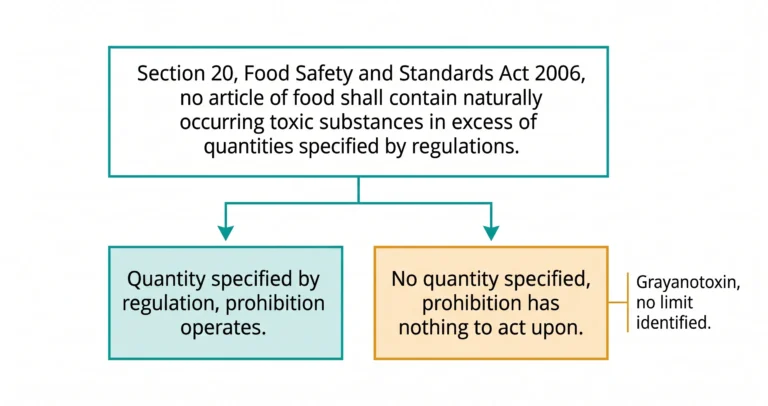
Section 20 provides that no article of food shall contain any contaminant, naturally occurring toxic substance or toxin, hormone, or heavy metal in excess of such quantities as may be specified by regulations.
The wording requires close attention, because it is not the test used in the United States or the United Kingdom. American law asks whether a quantity ordinarily renders food injurious to health. British law asks whether food is unsafe, with structured criteria for deciding. Both are substantive standards that a regulator or court can apply directly to evidence about a particular food. Section 20 is not a substantive standard in that sense. It prohibits quantities in excess of those specified by regulations, which means the prohibition is operative only where a regulation has specified a quantity for the substance in question.
Where no quantity has been specified, Section 20 has nothing to act upon. It does not fall back on a general injurious to health test, because it contains none.
| Jurisdiction | Form of the test | Does it function without a numeric limit? |
| India, FSS Act s.20 | Prohibits quantities in excess of those specified by regulations | No. A specified quantity is required for the prohibition to operate |
| United Kingdom, Art. 14 | Prohibits placing unsafe food on the market, with criteria for assessing injury | Yes. The criteria are applied to evidence about the food |
| United States, 21 USC 342 | Adulterated if the quantity ordinarily renders the food injurious to health | In principle, yes, though the absence of a tolerance leaves it unquantified |
Whether a quantity has been specified
The quantities contemplated by Section 20 are set in the Food Safety and Standards (Contaminants, Toxins and Residues) Regulations, 2011. No limit for grayanotoxin in honey was identified in those regulations or in the amendments located as of September 2026.
On that reading, Section 20 does not currently bite on grayanotoxin, because no specified quantity exists for it to exceed. This is a stronger statement than saying the position is unregulated. It is that the principal statutory provision addressing naturally occurring toxins in food has been drafted in a way that requires a regulation to activate it, and no such regulation has been made for this compound.
FSSAI published a draft amendment to the Contaminants, Toxins and Residues Regulations in 2024 addressing metal contaminants, crop contaminants, and naturally occurring toxic substances. That instrument is the most likely vehicle through which a grayanotoxin limit would be introduced if one were adopted. Its final notified form should be checked, since the position stated here would change if a limit has since been specified.
Honey standards do not fill the gap
India does maintain compositional standards for honey, and FSSAI strengthened them in 2018 by adding isotope ratio tests intended to detect adulteration with foreign sugars. Those standards are substantial and well enforced relative to many jurisdictions.
They do not address grayanotoxin. Their purpose is to establish that honey is honey rather than syrup, which is a question of authenticity and economic adulteration. A honey that passes every compositional and authenticity test in the Indian standard may carry any quantity of grayanotoxin, because no test in that standard looks for it.
Import and customs
Imported food is regulated under Chapter V of the Food Safety and Standards Act and cleared through the FSSAI Food Import Division at notified points of entry. Consignments require an import license held by the importer and are subject to inspection and sampling before clearance is granted.
Testing at clearance is conducted against the standards that exist. Since no grayanotoxin limit has been specified for honey, testing of an imported honey consignment would address compositional standards, contaminants for which limits have been set, and labelling compliance. No grayanotoxin-specific import condition, alert, or testing requirement was identified as of September 2026.
Consignments may still be refused on the ordinary grounds applying to any imported food, including failure to meet compositional standards, adulteration with foreign sugars, or misdescription on labelling.
Enforcement record
No prosecution, seizure, product recall, or FSSAI advisory concerning grayanotoxin or mad honey was identified as of September 2026.
This absence sits alongside a documented clinical record, and the juxtaposition is the most notable feature of the Indian position. Cases of wild honey intoxication have been reported in the Indian and Nepali medical literature, which establishes that exposure occurs in the region rather than being a purely theoretical possibility. The point is narrow and should not be overstated: clinical cases appear in the medical record without a corresponding regulatory or enforcement response having been identified.
What legal does not mean
Absence of a specified limit is not a finding of safety. Section 20 becomes operative when a regulation specifies a quantity, and no quantity has been specified for grayanotoxin, which leaves the question unaddressed rather than resolved in favour of any concentration. The same holds for mad honey under Texas law, where no concentration limit has been set.
The domestic production dimension deserves particular emphasis here. In jurisdictions where mad honey arrives only as an import, border controls provide at least a theoretical point of intervention. Honey produced and sold within India does not cross a border, so import controls are irrelevant to it, and the domestic provision that would otherwise apply is the one that requires a regulation to activate.
Concentration determines effect and is not visible on a label. The Cliff Mad Honey Safety Standard: GTX Concentration Risk Classification (v1.0) sets out how measured grayanotoxin concentrations are classified.
What is not established
Whether the consolidated Contaminants, Toxins and Residues Regulations and all amendments to date contain any grayanotoxin limit. The regulations were reviewed in the form located, and no limit was found, but the consolidated instrument should be read in full.
Whether the 2024 draft amendment on naturally occurring toxic substances has been notified in final form and whether it introduces a grayanotoxin limit.
Whether any Indian state has issued separate guidance on wild, cliff, or Rhododendron honey. State food authorities share enforcement responsibility under Section 29 and may act independently.
Key points
Mad honey is lawful to possess, buy, and consume in India. Grayanotoxin is not scheduled under the Narcotic Drugs and Psychotropic Substances Act, 1985, and the applicable framework is the Food Safety and Standards Act, 2006.
Section 20 of that Act prohibits naturally occurring toxic substances only in excess of quantities specified by regulations, and no quantity appears to have been specified for grayanotoxin, so the provision has nothing to operate on. India’s honey standards address authenticity and adulteration with sugars rather than toxin content, and do not fill the gap. Imports are cleared through the FSSAI Food Import Division against the standards that exist, and no grayanotoxin-specific import condition was identified. India is also a producing country, so domestic honey falls outside import controls entirely. No enforcement action was identified, notwithstanding a clinical record of wild honey intoxication in the region.
- Is Mad Honey Legal? Country by country legal status hub.
- Is Mad Honey Legal in the UK? An injurious-to-health test that operates without a specified limit.
- Is Mad Honey Legal in the US? A food classification reached by a third statutory route.
- Is Mad Honey Legal in the UAE? Food law again, beside a strict narcotics law whose schedules do not list grayanotoxin (checked 8 October 2026).
- The Cliff Mad Honey Safety Standard: GTX Concentration Risk Classification (v1.0).
Sources
- Food Safety and Standards Act, 2006, section 20. Provides that no article of food shall contain naturally occurring toxic substances or toxins in excess of such quantities as may be specified by regulations.
- Food Safety and Standards (Contaminants, Toxins and Residues) Regulations, 2011. Specifies limits for four naturally occurring toxic substances. Grayanotoxin is not among them, so no quantity limit is set for it.