Mad honey, honey containing grayanotoxins from Rhododendron species, is not a controlled substance under United States federal law and is not prohibited to possess, buy, or consume in any state as of September 2026.
That single sentence answers the question most people arrive with, but it conceals the more useful part of the picture. United States food law does not work by listing permitted and prohibited foods. It sets conditions that any food must meet, and whether mad honey meets them turns on a distinction in the statute that most discussion of this subject never reaches. The distinction is between substances added to a food and substances that were in it to begin with, and for mad honey it determines the entire analysis.
Contents
Legal classification
The United States classifies mad honey as a conventional food. It is regulated under the Federal Food, Drug, and Cosmetic Act in the same way as any other honey, with no separate category, no special authorization requirement, and no registration specific to grayanotoxin content.
Grayanotoxin does not appear in any schedule of the federal Controlled Substances Act. The consequence is straightforward. Possession, purchase, and consumption offenses under federal drug law attach only to scheduled substances, so none of them reach mad honey. There is no federal offense of possessing mad honey because there is no provision under which such an offense could arise.
This is worth stating precisely because the commercial literature frequently describes mad honey as existing in a regulatory grey area. It does not. Its classification is unambiguous. What is genuinely unsettled is a narrower question, addressed below, about the concentration at which a particular batch might fall foul of the general adulteration standard that applies to all food.
Governing instrument
The governing instrument is the Federal Food, Drug, and Cosmetic Act, and the operative provision is 21 U.S.C. 342, which defines when a food is adulterated. Introducing an adulterated food into interstate commerce is prohibited. The question for mad honey is therefore whether it is adulterated within the meaning of that section.
The added and not added distinction
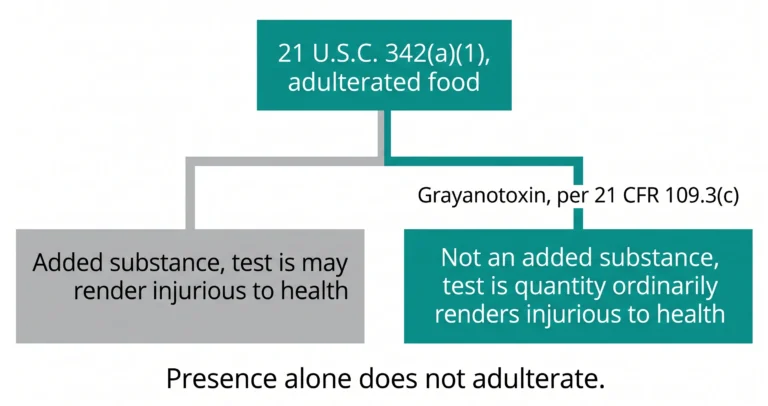
Section 342(a)(1) provides that a food is adulterated if it bears or contains any poisonous or deleterious substance which may render it injurious to health. Read alone, that clause would capture mad honey immediately, since grayanotoxin is unambiguously a poisonous substance capable of rendering honey injurious to health.
The clause does not stand alone. It continues with a proviso: where the substance is not an added substance, the food is not adulterated under that clause unless the quantity present ordinarily renders it injurious to health. The statute therefore creates two different tests depending on how the substance came to be in the food.
For an added substance, the test is whether the substance may render the food injurious. Presence of a sufficient quantity is close to determinative. For a substance that is not added, the test is whether the quantity present ordinarily renders the food injurious. Presence alone establishes nothing. The burden is materially higher and it is quantitative rather than qualitative.
| Added substance | Not an added substance | |
| Statutory test | May render the food injurious to health | Quantity present ordinarily renders the food injurious to health |
| Role of presence | Presence at a sufficient level is close to determinative | Presence alone establishes nothing |
| Nature of the question | Largely qualitative | Quantitative, and dependent on what is ordinary |
| Which applies to grayanotoxin | No | Yes |
Why grayanotoxin is not an added substance
Which limb applies is not left to argument. It is settled by regulation. 21 CFR 109.3(c) defines a naturally occurring poisonous or deleterious substance as an inherent natural constituent of a food that is not the result of environmental, agricultural, industrial, or other contamination.
Grayanotoxin in mad honey satisfies that definition on its face. It is produced by Rhododendron plants as a chemical defense, is present in the nectar those plants secrete, and passes into honey through ordinary foraging. Nothing is introduced at any stage of production. The compound is not a contaminant that entered honey through some failure of process, and it is not an ingredient that a producer decided to include. It is a constituent of the nectar, and therefore an inherent natural constituent of the honey made from that nectar.
Mad honey is accordingly assessed under the naturally occurring limb. The presence of grayanotoxin does not adulterate honey. The question is whether the quantity present in a particular honey ordinarily renders that honey injurious to health.
The question the statute leaves open
Having established the correct test, federal law then declines to answer it numerically. The FDA has set no tolerance, no action level, and no regulatory limit for grayanotoxin in honey. Section 346 of the Act provides the mechanism by which tolerances for poisonous or deleterious substances are established, and no such tolerance has been issued for grayanotoxin.
The effect is that whether a given honey is adulterated would be determined case by case, on evidence about that honey, against a threshold that has never been quantified. A honey at the upper end of the concentration range documented in the analytical literature and a honey with no detectable grayanotoxin are both lawful in the same sense and by the same route, because the question that would distinguish them has not been asked by any regulation.
Import and customs
Imported honey is subject to FDA oversight at the point of entry and to Customs and Border Protection requirements. Shipments may be detained or refused where a product appears adulterated or misbranded, on the ordinary grounds applying to all imported food.
Commercial importers carry an additional obligation under the Foreign Supplier Verification Programs rule, introduced by the Food Safety Modernization Act. That rule requires an importer to identify and evaluate the known or reasonably foreseeable hazards associated with each food it imports, and naturally occurring toxins fall squarely within the category of hazard the rule is designed to capture. An importer of mad honey conducting a hazard analysis would be expected to reach grayanotoxin. What the rule requires is that the hazard be evaluated and controlled, not that any particular concentration be achieved, since no concentration has been specified.
No FDA import alert specific to grayanotoxin or to mad honey was identified as of September 2026. Honey does appear on import alerts, and this is a point on which the commercial literature is frequently imprecise. The honey-related instruments located address economically motivated adulteration, principally undeclared added sweeteners, and separately the presence of unsafe drug residues. Both concern substances that do not belong in honey at all. Neither concerns a plant toxin that arrives with the nectar, and neither can properly be cited as evidence of FDA attention to grayanotoxin.
Enforcement record
No federal prosecution, seizure, recall, or import alert specific to grayanotoxin in honey was identified as of September 2026. No FDA consumer advisory naming mad honey was located.
The absence is not evidence that enforcement is unavailable. The powers exist and are routinely exercised against other foods. It reflects that the question appears not to have arisen in a form that produced a documented action, which is a different proposition from a determination that no action is warranted.
State law
State law adds nothing restrictive to the available record. No state was identified that schedules grayanotoxin as a controlled substance, and no state was identified that names mad honey in its food legislation.
The structural reason is that most state food statutes are modeled closely on the federal Act, including the added and not added distinction. A state analysis therefore tends to reproduce the federal analysis rather than diverge from it. The Texas page works this through in full for one state, and the result is the same conclusion reached by the same statutory route, which is what should be expected wherever the state statute tracks the federal model.
States do retain independent authority to schedule substances and to set food standards, so divergence is possible in principle. None was identified in practice.
What legal does not mean
Classification as a food is a statement about regulatory status. It is not a finding about physiological effect, and the two are frequently conflated in commercial descriptions of the United States position.
The absence of a tolerance for grayanotoxin does not mean a safe quantity has been identified. It means no quantity has been specified at all. The injurious to health threshold in section 342(a)(1) remains undetermined for this compound, which leaves the question open rather than resolved in favour of any particular concentration. An absence of regulation is not a grant of safety. India’s food law leaves a wider gap still, because its prohibition operates only once a regulation has specified a quantity.
Concentration is the variable that determines effect, and it varies substantially between batches of honey without being apparent from the jar or declarable on the label. The Cliff Mad Honey Safety Standard: GTX Concentration Risk Classification (v1.0) sets out how measured grayanotoxin concentrations are classified.
What is not established
No numeric threshold exists at which United States authorities would regard honey as adulterated by reason of grayanotoxin content. No tolerance, action level, or guidance value has been issued.
No determination has been made as to whether mad honey as a category satisfies the ordinarily renders it injurious test. The question would fall to be decided on the facts of a particular product, and no such decision was identified.
Whether any state departs from the federal model in a way that bears on this was not established across all fifty states.
Key points
Mad honey is lawful to possess, buy, and consume throughout the United States. It is classified as a conventional food, and grayanotoxin is not a scheduled controlled substance, so no possession offense exists at the federal level, and none was identified at the state level.
The governing test is the adulteration standard in 21 U.S.C. 342. Because 21 CFR 109.3(c) treats grayanotoxin as an inherent natural constituent rather than an added substance, presence alone does not adulterate honey, and the operative question is whether the quantity present ordinarily renders it injurious to health. Federal law has never answered that question numerically, so the standard exists without a threshold. Imported honey is subject to FDA and CBP oversight, and commercial importers must evaluate the hazard under the Foreign Supplier Verification Programs rule, but no grayanotoxin-specific import alert was identified. Neither was any federal enforcement action.
- Is Mad Honey Legal? Country by country legal status hub.
- Is Mad Honey Legal in Texas? The state-level analysis worked through in full.
- Is Mad Honey Legal in the UK? The same classification reached by a different statutory route.
- Is Mad Honey Legal in Canada? The neighbouring food law, with a 20 kg limit on honey brought in for personal use.
- The Cliff Mad Honey Safety Standard: GTX Concentration Risk Classification (v1.0).
Sources
- 21 U.S.C. 342(a)(1). The adulterated food test, including the proviso that a substance which is not an added substance adulterates food only if its quantity ordinarily renders the food injurious to health.
- 21 CFR 109.3. Defines a naturally occurring poisonous or deleterious substance as an inherent natural constituent of a food, and distinguishes it from an added substance.